Translate

Zoeken in deze blog

zondag 21 juli 2024

Tychy

Tychy (uitspraak: [ˈtɨxɨ]?, ong. tichi) (Duits: Tichau) is een stad in het Poolse woiwodschap Silezië. Het is een stadsdistrict en gelegen in het zuidelijke deel van het land. De oppervlakte bedraagt 81,62 km², het inwonertal 131.547 (2005).... Archeologische vondsten op het kerkhof in het stadsdeel Cielmice duiden er op dat al sinds het paleolithicum het gebied al bewoond is. In het jaar 874 werd de omgeving deel van het Groot Moravische Rijk, na de ondergang in het jaar 985 kwam het gebied de Poolse hertog Mieszko I. Hierdoor werd het gebied vanaf 1025 onderdeel van het koninkrijk Polen. (https://nl.wikipedia.org/wiki/Tychy)

The moniker Tychy is derived from the Polish word cichy, meaning "quiet" or "still".[6] Although appropriate for most of Tychy's history, the name is now somewhat ironic considering the growth of the city from 1950 onwards. (https://en.wikipedia.org/wiki/Tychy)

Tychy (Polish pronunciation: [ˈtɨxɨ] ⓘ; German: Tichau; Silesian: Tychy) is a city in Silesia in southern Poland, approximately 20 kilometres (12 mi) south of Katowice. Situated on the southern edge of the Upper Silesian industrial district, the city borders Katowice to the north, Mikołów to the west, Bieruń to the east and Kobiór to the south. The Gostynia river, a tributary of the Vistula, flows through Tychy. .... Since 1999, Tychy has been located within the Silesian Voivodeship, a province consisting of 71 regional towns and cities. Tychy is also one of the founding cities of the Metropolitan Association of Upper Silesia, a pan-Silesian economic and political union formed with the eventual aim of bringing the most populous Silesian areas under a single administrative body. Tychy is well known for its brewing industry and the Tyskie brand of beer, which dates back to the 17th century.[3] Since 1950, Tychy has grown rapidly, mainly as a result of post-war socialist planning policies enacted to disperse the population of industrial Upper Silesia.[4][5] (https://en.wikipedia.org/wiki/Tychy)

Originally established as a small agricultural settlement on the medieval trade route between Oświęcim and Mikołów, Tychy was first documented in 1467.[7] In 1629 the first trace of serious economic activity was recorded in the shape of the Książęcy Brewery, which is now one of the largest breweries in Poland.[8] From 1526 onwards the area on which Tychy is built was part of the Austrian Habsburg monarchy. Then in 1742 Prussia annexed the land after winning the First Silesian War against the Austrian Hasburg monarchy. In 1871 the territory became part of the German Empire until in 1918, for a short period between 1918 and 1921 Tychy was just inside the border of the newly formed Weimar Republic and still a part of the German Province of Silesia. On 16–17 August 1919 the Battle of Paprocany [pl] (present-day district of Tychy) was fought as one of the first battles of the Silesian Uprisings (1919–1921). After the uprisings Tychy was reintegrated with the re-established Polish state. Additionally, due to the Polish majority in 1921 in Tychy and the few Germans, 84% of the inhabitants voted for joining Poland during the plebiscite.[9] Shortly after its cession to Poland, Tychy began to develop into a small urban settlement, acquiring a hospital, a fire station, a post office, a school, a swimming pool, a bowling hall and a number of shops and restaurants. In 1922 it was visited by leader of interwar Poland, Józef Piłsudski.[10] Its population also grew between World War I and World War II, reaching a population of 11,000 at its highest point during this time.[7] ... Along with the rest of industrial Upper Silesia Tychy was occupied by Nazi Germany forces after the invasion of Poland and annexed into the Third Reich,[11] while many of its inhabitants who were not expelled or exterminated were forced to change their nationality to German in order to comply with the racist policies of Nazi Germany.[12] Mass arrests and executions of Polish activists and former Polish insurgents of 1919–1921 were carried out in the first days of the occupation in September 1939.[1]... Tychy received minimal damage during the invasion because most of the nearby fighting took place in the Mikołów-Wyry area.[7] In the final stages of the war, in 1945, a German-conducted death march of thousands of prisoners of the Auschwitz concentration camp and its subcamps passed through the city towards Gliwice.[19] Tychy was liberated on January 28, 1945.[10] ... The "New City" was designated by the Polish government in 1950 and deliberately located near to Katowice with the intention that it would not be a self-sustaining city. It was granted town rights in 1951.[10] Tychy is the largest of the so-called "new towns" in Poland and was built from 1950 to 1985, to allow for urban expansion in the southeast of the Upper Silesian industrial region. ...  In the administrative reforms which came into effect in 1999, Tychy was made a city with the status of a powiat (city county). Between 1999 and 2002, it was also the administrative seat of (but not part of) an entity called Tychy County (powiat tyski), which is now known as the Bieruń-Lędziny County. Brewery in Tychy on the right, Tyskie Brewing Museum on the left The Tyskie Brewing Museum was founded in 2004, and the Municipal Museum in 2005.[10] (https://en.wikipedia.org/wiki/Tychy)

Princely Brewery Tychy (Polish Tyskie Browary Książęce) or Tychy Brewery in the town of Tychy is one of the largest breweries in Poland. It is operated by the Kompania Piwowarska company. It traces its history to the 17th century. The brand of beer produced by the brewery is Tyskie. Today, the premises host a beer museum "Tyskie Brewing Museum" (Polish Tyskie Browarium). During a 2009 vote the brewery complex was voted, as one of the "Seven Architectural Wonders of the Silesian Voivodeship."[1] (https://en.wikipedia.org/wiki/Tychy_Brewery)

The Tyskie Brewing Museum or Tyskie Browarium is a museum in Tychy in Silesia, Poland. It was established in 2004. The museum is an Anchor point on the European Route of Industrial Heritage. [1] It is an object of cultural heritage in Silesia (259/10), and a Polish national monument (641660).  During a 2009 vote the brewery complex was voted as one of the "Seven Architectural Wonders of the Silesian Voivodeship."[2] (https://en.wikipedia.org/wiki/Tyskie_Brewing_Museum)

Silesian Voivodeship (Polish: województwo śląskie [vɔjɛˈvut͡stfɔ ˈɕlɔ̃skʲɛ] ⓘ) is a voivodeship, or province, in southern Poland centered on the historic region known as Upper Silesia (Górny Śląsk), with Katowice serving as its capital. Despite the Silesian Voivodeship's name, most of the historic Silesia region lies outside the present Silesian Voivodeship – divided among Lubusz, Lower Silesian, and Opole Voivodeships. The eastern half of Silesian Voivodeship (and, notably, Częstochowa in the north) was historically part of Lesser Poland. The Voivodeship was created on 1 January 1999 out of the former Katowice, Częstochowa and Bielsko-Biała Voivodeships, pursuant to the Polish local government reforms adopted in 1998. It is the most densely populated voivodeship in Poland. Within the area of 12,300 square kilometres, there are almost 5 million inhabitants.[4] It is also the largest urbanised area in Central and Eastern Europe.[5] ... Silesian Voivodeship has the highest population density in the country (379 people per square kilometre, compared to the national average of 124). The region's considerable industrialisation gives it the lowest unemployment rate nationally (6.2%). The Silesian region is the most industrialized and the most urbanized region in Poland: 78% of its population live in towns and cities. (https://en.wikipedia.org/wiki/Silesian_Voivodeship)

Tyskie beer has been on sale since 1629. The brewery, then called "Fürstliche Brauerei in Tichau", produced three kinds of beer: mailings, yeast and tableware. Only the high quality beer was intended for sale, and the other two were a beer allowance drunk mainly by brewers and their families. In the early 19th century, the brewery produced only two beverages: beer and Bavarian malt, both top-fermenting. Bavarian malt with a classical composition, saturated color was brown, sweet, calorie and low-hopped. The standard was the dark weak niskoekstraktowe, that was only for immediate consumption. Prince Jan Henryk XI rebuilt the brewery 1861, he introduced a steam engine. Production rose to 100.000 hectoliters a year, making the brewery one of the largest beer producers in Europe. After the expansion and the introduction of bottom-fermenting, they started to produce beer in March, called Tyskie lager, a relatively short Bavarian beer. The first beers were light and were sold under the Książęce brand. The brewery was electrified in 1891 and was linked to the railway network in 1894. In the interwar period, popular brands from Tyskie were the Książęce Tyskie Pilsen, the Książęce Tyskie Export, the Książęce Tyskie full beer, and Tyskie Porter. Today the Tyskie Górny Śląsk brewery is owned by Kompania Piwowarska, itself a subsidiary of SABMiller established in Poland in 1999 as a result of the merger of two SABMiller owned Polish breweries, this one and the Lech Brewery Wielkopolski in Poznań.[1] (https://en.wikipedia.org/wiki/Tyskie_Brewing_Museum)

Kompania Piwowarska is a Polish brewing group based in Poznań, established in 1999. Since 2017 it has been owned by Asahi Breweries. Kompania Piwowarska currently has three breweries: Lech Browary Wielkopolski in Poznań, Tyskie Browary Książęce in Tychy and Browar Dojlidy in Białystok. Tyskie Browary Książęce (Princely Brewery Tychy), one of the oldest breweries in Europe, was founded in 1629.[1] The three breweries have a total capacity of 15.1 million hectolitres.[2] The company was owned by SABMiller from 2009 to 2017. As part of the agreements made with regulators before Anheuser-Busch InBev was allowed to acquire SABMiller in 2016, it was announced on December 13, 2016, that Kompania Piwowarska would be sold to Asahi Breweries of Japan.[3][4][5][6] ... Kompania Piwowarska currently controls 45% of the Polish beer market.[citation needed] Lech Lech Premium The main Lech brands are Lech Premium a 5.0% abv pale lager, Lech Pils 5.5% pale lager Lech controls 8% of the Polish beer market.[7] The Poznań brewery brews Dębowe Mocne (Oak Strong), which is 7%. Currently produced types are "Lech Premium", "Lech Pils" Tyskie See also: Tyskie Brewing Museum Tyskie logo Tyskie is one of the best selling brands of beer in Poland, with around 18% of the Polish market.[8] Tyskie also has a world distribution. The main brands are Tyskie Gronie, a 5.0% pale lager,[9][10] Dojlidy Main article: Dojlidy Brewery The main Dojlidy Brewery brand is the 6% pale lager, Żubr (European bison). (https://en.wikipedia.org/wiki/Kompania_Piwowarska)

Tyskie (Polish: [ˈtɨskʲɛ]) is a Polish brand of beer. Its name comes from the brewery located in the Upper Silesian town of Tychy. It is brewed by the Tychy Princely Brewery (Polish Tyskie Browary Książęce), part of the Kompania Piwowarska brewery group, which was acquired by Asahi Group Holdings in 2017.[1] ... The main brands are Tyskie Gronie (pale lager). ... The brewery is one of the oldest in Europe. Beer has been produced in Tychy continuously for almost 400 years. From 1629, the brewery, then known in German as the "Fürstliche Brauerei Tichau" (Princely Brewery Tychy), was in the ownership of the German noble House of Promnitz [de]. From 1861, the brewery became known as the "Fürstliche Brauerei in Tichau" (Princely Brewery in Tychy) and came under the management of Hans von Hochberg [de] from the German princely (German Fürsten) House of Pless. Between 1918 and 1939, the brewery merged with neighbouring competing companies, but came under provisional administration of the Polish state intermittently from 1934 due to unpaid taxes. During World War II, the brewery was put under the management of the occupying authorities.[2]... In its beginnings, the brewery produced three kinds of beer: mailings, yeast and tableware.[clarification needed] Only the high quality beer was intended for sale, and the other two were a beer allowance drunk mainly by brewers and their families. In the early nineteenth century the brewery produced only two beverages: beer and Bavarian malt, both top-fermenting. Bavarian malt with a classical composition, saturated color was brown, sweet, and low-hopped. The standard favorite was the dark niskoekstraktowe, weak and only for immediate consumption. After the expansion of the brewery in the nineteenth century and the introduction of bottom-fermenting, they started to produce Tyskie lager, a relatively short Bavarian beer. The first beers were light and were sold under the Książęce brand. In the interwar period, popular brands from Tyskie were the Książęce Tyskie Pilsen (Princely Tychy Pilsner), the Książęce Tyskie Export, the Książęce Tyskie Beer full, and Tyskie Porter. ... Tyskie is one of the leading brands of beer in Poland, with around 18% of the Polish market.[3] Tyskie also has a large export distribution through its parent company. The main export brands are Tyskie Gronie, a 5.0% pale lager[4][5] Tyskie Gronie is 5.2% ABV in produced by Tychy Brewery Princely. Tyskie Gronie (abv 5.0%) is also brewed and canned by the Grolsche brewery in Enschede, Netherlands, for the UK market (imported by Asahi UK Ltd).... Tyskie bottles are known for their distinctive white packaging. The label depicts a royal crown to commemorate John III Sobieski king of Poland, who was born in 1629, the same year the family von Promnitz established a brewery in the town of Tychy.[6]... In 2004, the Tyskie Brewing Museum was founded on the brewery premises in Tychy. The Tyskie Brewing Museum represents an important "anchor point" of the European Route of Industrial Heritage in Poland. (https://en.wikipedia.org/wiki/Tyskie)

The brewery in Tychy is one of the oldest in Europe, from 1629, with beer produced continuously for almost 400 years. Originally in German control, it took a while before it was in actual Polish hands, what with the Wars and all against their neighbours, and that’s where it has remained since………..albeit In 2016 the Japanese group, Asahi Group Holdings, acquired the brand from Anheuser-Busch InBev.  The main brands are Tyskie Gronie (a 5.5% pale lager) and Książęce Tyskie (5.7% classic lager) premium beers. (https://www.thisdrinkinglife.com/tyskie-gronie/)

Tyskie Brewery, located in the town of Tychy in southern Poland, is one of the country's oldest and largest breweries. Not far off celebrating its 400th birthday, it was founded in 1629, so has survived numerous wars and political upheavals over the centuries. Today, Tyskie is part of the Asahi Group, having been acquired in 2017 to bolster the Japanese giant's presence in Europe.  (https://www.onlycans.me/blog/tyskie-gronie-beer-review-taste-of-the-summer)

Visit the Brewery! Watch how be brew Tyskie and dive deep into the beer stories. We give you access to an architectural jewel and a modern brewery, where beer has been brewed uninterruptedly since its establishment in 1629. That’s where the Tyskie and Książęce beer recipes were developed. ...  where the Tyskie beer has been brewed uninterruptedly for four centuries ... Visit the Brewery! Watch how be brew Tyskie and dive deep into the beer stories. We give you access to an architectural jewel and a modern brewery, where beer has been brewed uninterruptedly since its establishment in 1629. That’s where the Tyskie and Książęce beer recipes were developed. You will discover the fascinating history of Tyskie Browary Książęce and the incredibly strong multigenerational relationship between the local community and the Brewery. You will get a chance to admire historic photos of generations of brewers recreated on murals, including one of the biggest ones in Poland. In the Brewing Art Centre, you will use your senses to experience what goes into creating good beer and explore the sensory profiles of the Tyskie and Książęce beers. The Beer Laboratory awaits you with various artefacts and best types of raw materials. You can literally touch the brewing craft here. The historic brick cellars of Tyskie Browary Książęce house the Pod Browarem pub, where the tour will culminate with a presentation of the right pouring techniques and tasting of the Tyskie Gronie from the Brewery, freshly brewed merely a few meters above the venue. The store located on the Brewery premises offers branded souvenirs from the world’s most popular Polish beer brand, while the Pod Browarem pub provides fresh Tyskie Gronie from the Brewery in a stylish swing-top bottle. (https://browarytyskie.pl/en/schedule-a-visit/)

Things to see in the Brewery It’s not just a brewery… it’s a village, considered a cultural heritage of Poland, Silesia and Tychy. It’s where people brewed beer, worked, gave birth, prayed, played and lived. Tyskie Browary Książęce encompasses the history of many generations – families that had built a unique community within the Brewery premises. Tyskie Browary Książęce has its own streets, pedestrian and car traffic, and the buildings have specific functions. The properties located on the “old” side are entered into the register of historic monuments. (https://browarytyskie.pl/en/schedule-a-visit/)

Tychy Brewery Museum... ul. Katowicka 9, Tychy 43-100 Polen... Diverse brouwerijen in Polen bezocht, maar dit is toch echt wel de mooiste. Veel oude(re) elementen en een goed verhaal van de gids die ons heeft rondgeleid. Uiteraard afsluiting van de tour met een biertje uit de brouwerij. (https://www.tripadvisor.nl/Attraction_Review-g274790-d2711409-Reviews-Tychy_Brewery_Museum-Tychy_Silesia_Province_Southern_Poland.html)

The brew house in the Tyskie brewery in the upper Silesian town of Tychy makes a truly palatial impression with its blue glazed tiles adorned with flowers, richly decorated pillar capitals, a precious panelled ceiling, and an interior full of blank copper brewery kettles, valves and instruments, hand wheels and shining pipelines. The bottles still carry the family coat-of-arms of the Princes of Promnitz who began the local brewing tradition in 1629. A comprehensive tour of the museum reveals how Tychy beer is brewed, and all that has changed over the last 400 years. The tour begins in the historic part of the brewery that consists of listed 19th and early 20th century clinker buildings. The director’s villa has its place here, as do the malting works, the malt house, the brew house, the cooperage and other production sites, all of which are equipped with the most up-to-date brewery technology. For the works are still running to full capacity. Not for nothing is there a brand-new bottling and dispatching plant right next door. The tour ends in the old chapel that now houses the brewery museum. It includes multimedia stations, a 3-D film and a glass of freshly tapped Tychy beer! (https://www.erih.net/i-want-to-go-there/site/tyskie-brewing-museum)

Tychy Brewery Museum... ul. Katowicka 9, Tychy 43-100 Poland... Guided tour throug Tyskie Brewery Museum is quite atractive for history lovers. Do not expect a lot of interactive activity overhere. ... The brewery guide is professional and very patience with us. He shared the process and the history. We also get to see the old and modern automatic brewery. Furthermore watched a 3D show too and finally got a 14day brew drink.  (https://www.tripadvisor.com/Attraction_Review-g274790-d2711409-Reviews-Tychy_Brewery_Museum-Tychy_Silesia_Province_Southern_Poland.html)

The people in the Upper Silesian town of Tychy have been making a beer called Tyskie that has been on the market since 1629. Today it is the most brewed beer in Poland. Visitors can find out how this came to be when they take a tour of the brewery where everything began. The foundation stone was laid by the Princes of Promnitz who resided in a nearby castle in Pszczyna in the 17th century. But brewing only really began on a larger scale with Prince Jan Henryk XI, who had the brewery rebuilt from the foundations in 1861, complete with a steam engine. The upshot was that production rose to 100.000 hectolitres a year, a fact which ensured the brewery a place in the ranks of the largest beer producers in Europe. Many of today’s brewery buildings date back to this time. In 1890 the brewery was electrified and three years later it was linked to the railway network. In 1920 the first garage was built to house the delivery lorries. The Second World War left the brewery almost ruined. But during the years that followed it slowly and continually began to recover. At the start of the 1990s the Tyskie brewery was rapidly modernised. Output rose to such an extent that it was necessary to construct a new bottling and dispatching plant that went into operation in June 1998. At the same time the brewery made clear how conscious it was of its long traditions, when it began work on restoring the historic factory buildings in 2000. One of the most particularly splendid buildings is the brew house and its original technical equipment, that was originally built between 1916 and 1922. Today the Tyskie Brewery belongs to the South African beer company, SAB Miller. The modern brewery museum opened its doors in 2004 and is the first museum of its kind in Poland. The exhibition invites visitors to play an active role, and brings back to life the history of the brewery in an illuminating manner. The works and the museum are situated on an industrial heritage trail linking a number of different technical monuments in the Silesian province. (https://www.erih.net/i-want-to-go-there/site/tyskie-brewing-museum)

Museum of Brewing in Tychy – Tyskie Brewery... The museum is situated in the buildings of a former evangelical church from 1902 on the site of the Prince’s Brewery in Tychy. It was opened to the public in 2004. In the museum hall are exhibits connected with the art of brewing, serving and drinking beer as well as about the history and traditions of the brewery in Tychy. Exhibits include over 300 bottles from the beginning of the 19th century, cooper’s tools, original oak barrels, beer mugs, coasters, labels, bottle caps, documents, photographs relating to beer and its history and the story of the Tychy Brewery. All this in a modern setting, using the latest museum techniques. The newly refurbished museum cinema shows a film about the history of the Pszczyna lands and the Prince’s Brewery in Tychy in 3D technology. The room is also filled with touch screens presenting the history of the brewery and the manufacturing process, beer games and a mail barrel from which visitors can send e-mails to their friends. Since 2005, the museum has introduced a programme of nightly tours under the slogan “See the Brewery at Night”. Tours include shows by amateur actors taking the roles of historical figures associated with the history of the brewery. Tyskie Brewery (Museum of Brewing in Tychy) – Tychy (woj. Slaskie) www.tyskiebrowarium.pl... polen.travelToeristische attractiesMuseum of Brewing in Tychy – Tyskie Brewery  Museum of Brewing in Tychy – Tyskie Brewery .... A wide collection of exhibits relating to the history of brewing, the Pszczyna lands and the Tychy Brewery The museum is situated in the buildings of a former evangelical church from 1902 on the site of the Prince’s Brewery in Tychy. It was opened to the public in 2004. In the museum hall are exhibits connected with the art of brewing, serving and drinking beer as well as about the history and traditions of the brewery in Tychy. Exhibits include over 300 bottles from the beginning of the 19th century, cooper’s tools, original oak barrels, beer mugs, coasters, labels, bottle caps, documents, photographs relating to beer and its history and the story of the Tychy Brewery. All this in a modern setting, using the latest museum techniques. The newly refurbished museum cinema shows a film about the history of the Pszczyna lands and the Prince’s Brewery in Tychy in 3D technology. The room is also filled with touch screens presenting the history of the brewery and the manufacturing process, beer games and a mail barrel from which visitors can send e-mails to their friends. Since 2005, the museum has introduced a programme of nightly tours under the slogan “See the Brewery at Night”. Tours include shows by amateur actors taking the roles of historical figures associated with the history of the brewery. Tyskie Brewery (Museum of Brewing in Tychy) – Tychy (woj. Slaskie) www.tyskiebrowarium.pl.....Map data © OpenStreetMap contributors, CC-BY-SA (https://www.polen.travel/nl/toeristische-attracties/museum-of-brewing-in-tychy-%E2%80%93-tyskie-brewery)

Proost!

Ik heb een rondje gelopen rond de brouwerij:


De brouwerij is een leukere toeristische attractie dan een concentratiekamp. Wat een bizar contrast.


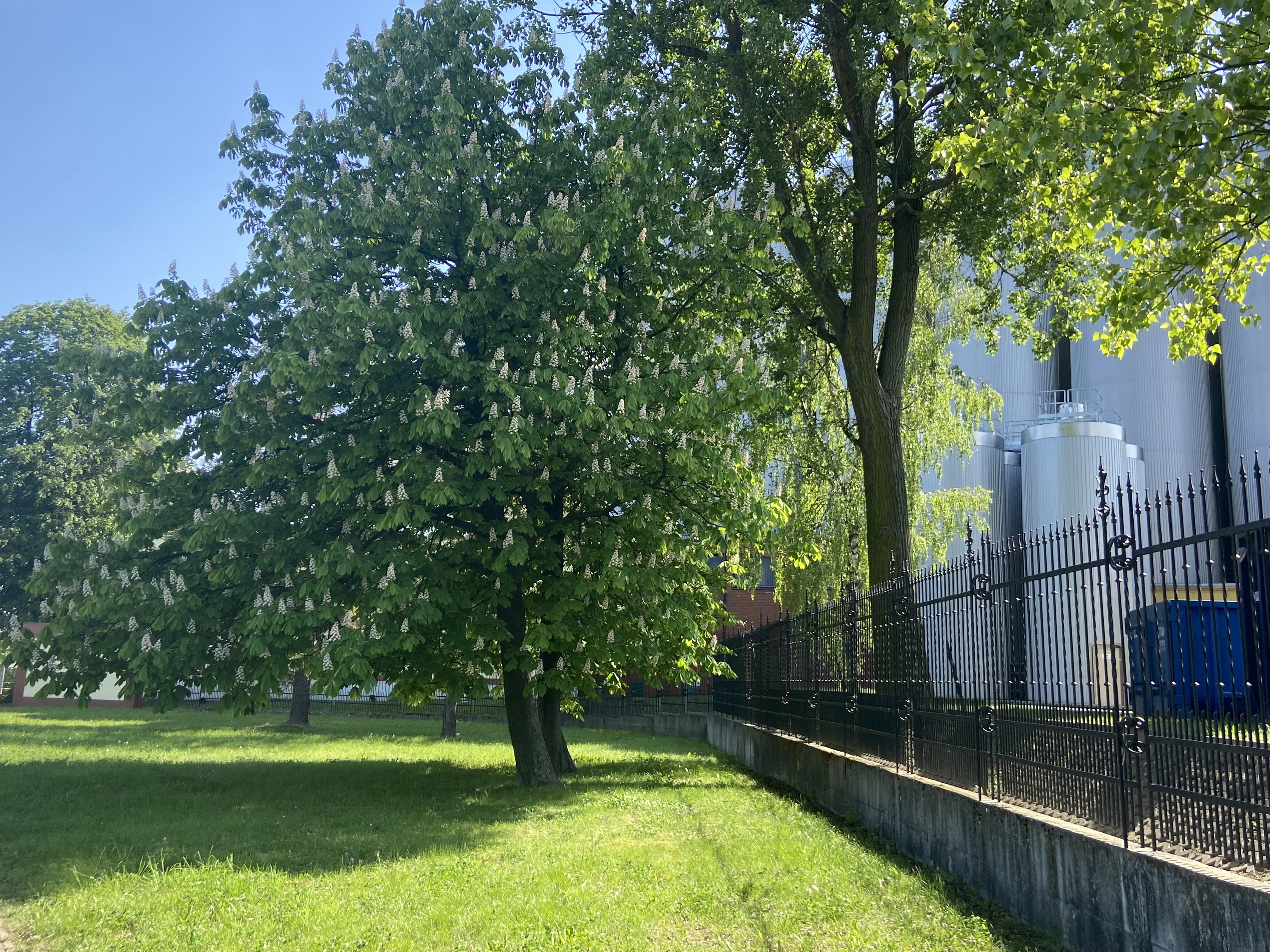
Er is hier vast genoeg bier opgeslagen, in al die opslagtanks:




Aan de overzijde van de straat is een opvallend begroeid huis:


De brouwerij zelf valt op door de opslagtanks:


Er is zelfs een bushalte bij de brouwerij!


Het is zelfs een monument?


Je herkent de oude bouwstijl in de gebouwen. Het is industrieel erfgoed dat goed past bij de rest van het plaatsje. 

Helaas was de rondleiding net vertrokken toen ik er was, en het museum was ook dicht. 

Kompania Piwowarska is the largest brewer in Poland. Hundreds of years of experience in beer brewing, state-of-the-art technology and rigorous adherence to the World Class Manufacturing principles guarantee the highest quality beer. The company’s product portfolio includes Tyskie – Poland’s favourite beer, Żubr – the second largest Polish brand of beer, Lech, Dębowe Mocne, Pilsner Urquell, Redd’s, Dog in the Fog, Peroni Nastro Azzurro and Miller Genuine Draft. Kompania Piwowarska was established in 1999 as a result of a merger of Tyskie Browary Książęce and Lech Browary Wielkopolski. (https://blogs.transparent.com/polish/tyskie-polish-beer/)

Zie blikjes Tyskie:  https://browarytyskie.pl/wp-content/themes/tbk/assets/files/tyskie_gif_2_v2_1.mp4 

In 2002, Tyskie Gronie won The Brewing Industry International Awards, receiving the two most prestigious awards - Gold Medal and Grand Prix. In 2005 in Munich at a global beer fair hosted by Drink Tec, Tyskie again received the Grand Prix. In 2011 Tyskie received the Gold Medal du Monde Selection – International Institute for Quality Selections. (https://en.wikipedia.org/wiki/Tyskie)


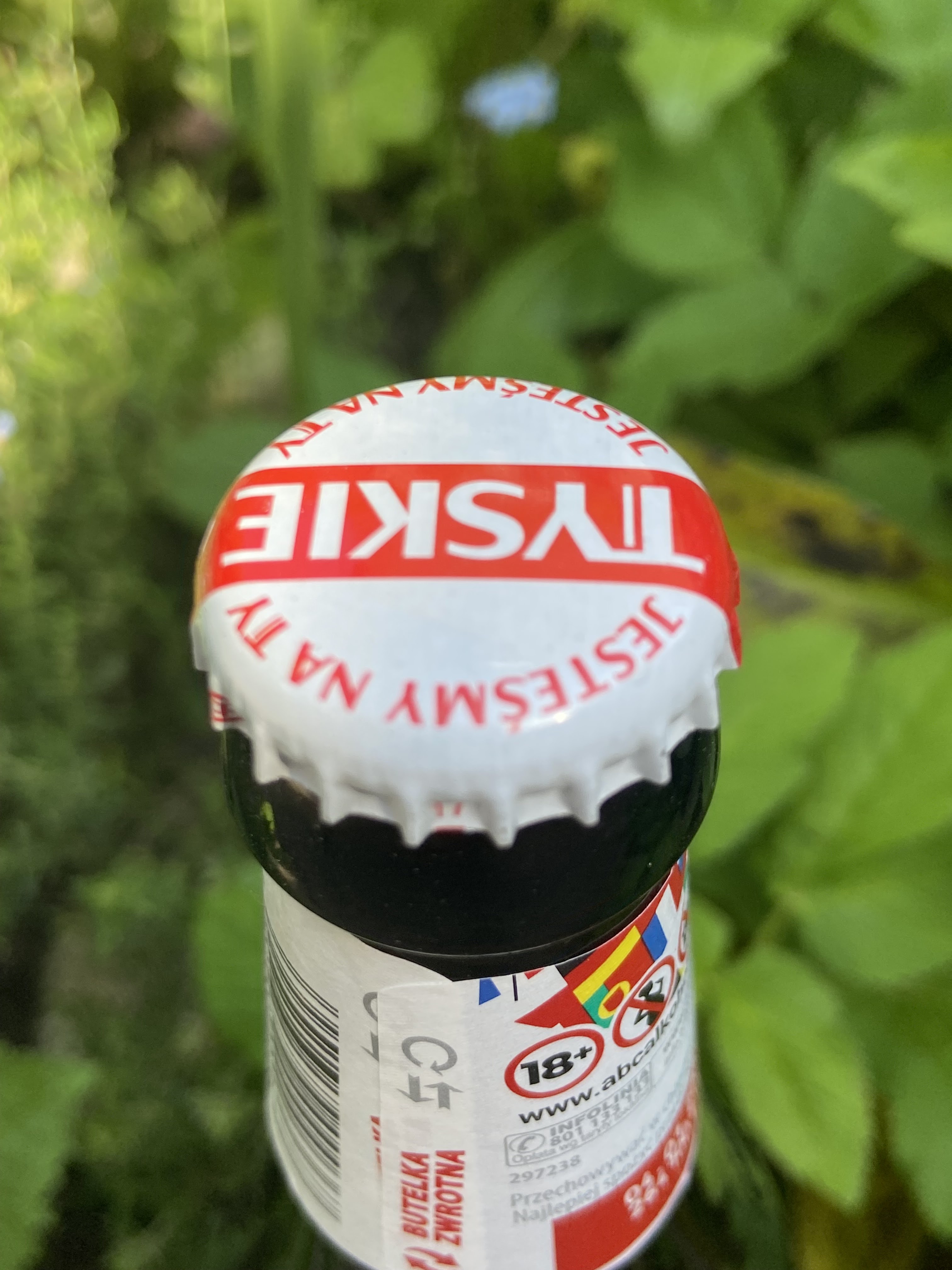
Tyskie Gronie smaakte als een duidelijke pils. Maar dat is een omschrijving van niks. Hoe omschrijven anderen het?

The beer has a light golden colour and a medium body, with a moderate amount of carbonation (https://www.onlycans.me/blog/tyskie-gronie-beer-review-taste-of-the-summer)

Tyskie is a pattern Gronie taste lager in the world. Perfectly composed flavor profile provides a strong bitterness and malt fully, while satisfying the desire. Tyskie is made from carefully selected ingredients: malted barley, hops and water, using natural yeast in the beer fermentation. Perfectly given Tyskie Gronie attracts the attention of a thick white foam, clarity, and light golden color. Seasoned drinker senses in the notes of malt, delicate aroma of hops, and even touches of apple and banana. Gronie years gaining recognition in Poland and in the world. As the only Polish beer, twice won the "Beer Oscars" - Grand Prix at The British Brewing Industry Awards, the most prestigious beer competition in the world. (https://www.beeradvocate.com/beer/profile/1941/5280/)

Strong bitterness in the hops, in the initial mouth feel and taste, as opposed to the aftertaste. Lots of breadiness...but highly fermented breadiness. Maybe a bit too musch malty breadiness. And the mouth feel is a little simple and primarily in the initial gulp. The aftertaste is far too powerful. First sip was best, but the more one has, the worst it seems to taste. Aroma is really amazing though, as is the look. Dec 11, 2023 (https://www.beeradvocate.com/beer/profile/1941/5280/)

The overall taste of Tyskie is a light, sweet, and slightly dry flavor with a moderate hop presence. The bitterness from the hops and the roasted malts give it a slight bitter aftertaste that is quite pleasant and not overpowering. (https://www.coalitionbrewing.com/what-does-tyskie-taste-like/)

Hier is zelfs een filmpje te zien: https://www.coalitionbrewing.com/what-does-tyskie-taste-like/

Lovely smell although a bit tinty and stringent, of light citrus. Bit soapy on initial taste, a very industrial taste. Hoppy and too sweet at start. Bit sickly. Not nice. Creamy mouth feels. (https://www.thisdrinkinglife.com/tyskie-gronie/)

Tyskie Gronie is een van de populairste bieren van Polen. Het is een ondergistend bier met een uitstekende doordrinkbaarheid. Het goudgele bier heeft een prachtige witte schuimkraag en heeft een bescheiden hopbitterheid. (https://www.bierista.nl/tyskie-gronie)


Lech Browary Wielkopolski (Polish pronunciation: [ˈlɛɣ brɔˌvarɨ vjɛlkɔˈpɔlskʲi];[1] English: Lech Breweries of Greater Poland) is a big industrial brewery in Poznań, with a production capacity of 7.5 million hl. The plant is owned by Asahi Breweries subsidiary Kompania Piwowarska SA.... The modern brewing plant in Poznań was built between 1975 and 1980. In 1984, a malthouse was added. By 1992, along with other brewers, it was part of Wielkopolskie Zakłady Piwowarsko-Słodownicze SA, but after 1992, it became the company's main production facility, Lech Browary SA. In 1993, the ministry decided to privatize the ownership of the brewery. As a result of the tender a majority shareholder in the company was Euro Agro Centrum Poznań, owned by entrepreneur Jan Kulczyk.[2] In 1996, the brewery was taken over by South African Breweries, which in the same year, together with Jan Kulczyk, purchased the Tyskie Brewery. Three years later, the two breweries were combined to form Kompania Piwowarska. On 11 March 2007, at the newly opened section of the brewery, the world's biggest beer mug was erected and filled with Lech Pils beer, setting a Guinness world record for the largest number of people drinking from one mug, which included 4250 liters of beer. The establishment of the record was attended by 10,625 people.[3] On 31 July 2010, an advertisement containing words "Zimny Lech" (Cold Lech) was placed near Wawel. The controversy was that in Polish, "zimny Lech" means both cold Lech (beer), and can coincidentally mean cold (body of) Lech (Kaczyński), the former president of Poland, who was buried in Wawel on 18 April 2010.[4] On 2 August 2010, it was announced that the advertisement would be removed from near Wawel, as well as from other cities.[5] In 2017, Kompania Piwowarska was acquired by Asahi. (https://en.wikipedia.org/wiki/Lech_Browary_Wielkopolski)

Ik heb Lech gedronken volgens mij, maar kan het niet anders omschrijven als een prima pils.

Żubr beer (Polish for Bison) is a Polish lager brewed by the Kompania Piwowarska SA. It was formerly known as Dojlidy, the name of the brewery in the Białystok district of Dojlidy, where it is produced. ... Żubr has been brewed since the Dojlidy Brewery opened in 1768. The Białystok based brewery was bought by the SABMiller subsidiary Kompania Piwowarska SA in 2003. The brew contains 12.1% (by weight) of extract content and 6.0% alcohol.[1] Currently it is brewed at three Kompania Piwowarska breweries: Białystok, Poznan and Tychy.... In April 2016, Kompania Piwowarska launched another special beer on the market. Prażubr is an unpasteurized lager with moderate bitterness and an alcohol content of 5% vol. It is available in returnable bottles and in 500 ml cans. His recipe was developed at the Dojlidy Białystok brewery. The product's name refers to the steppe bison – a mammal from the Pleistocene period, related to today's European bison. Advertising spots also emphasize the similarity between these species. (https://en.wikipedia.org/wiki/%C5%BBubr_(beer))

zaterdag 20 juli 2024

Krakau

Krakau wordt gezien als de mooiste stad van Polen. (https://www.reisroutes.nl/blog/polen/bezienswaardigheden-polen/) 

Krakau (Pools: Kraków [ˈkrakuf]?, Jiddisch: Kroke) is met 774.839 inwoners (30 juni 2019) na Warschau de grootste stad van Polen. De stad ligt op een hoogte van 188–393 meter boven zeeniveau aan de Wisła in het zuiden van Polen en is de hoofdstad van het woiwodschap Klein-Polen (Małopolska). Krakau was gelegen aan de Via Regia, het was een Hanzestad en tot 1609 was het de hoofdstad van Polen. Daarnaast is het een bisschopstad. (https://nl.wikipedia.org/wiki/Krakau)

Krakau is een van de belangrijkste cultuursteden van Midden-Europa. Het wordt daarom wel het "Florence van Polen" genoemd, en is volgens velen een van de mooiste steden van Europa. De stad kwam als een van de weinige steden in Polen bovendien vrij ongeschonden de Tweede Wereldoorlog door, al werd de Joodse wijk Kazimierz tijdens de Duitse bezetting wel in hoge mate verwoest.[1] Het stadscentrum staat op de Werelderfgoedlijst van de UNESCO. Krakau is een literatuurstad en was in 2000 culturele hoofdstad van Europa. (https://nl.wikipedia.org/wiki/Krakau)

Krakau kent een sfeervolle oude stad, de Stare Miasto. Dit deel van de stad staat sinds 1978 op de Werelderfgoedlijst van UNESCO. Het middelpunt van de oude stad is het plein Rynek Glówny, de Grote Markt (https://www.reisroutes.nl/blog/polen/bezienswaardigheden-polen/) 

Het museum Rynek Underground is het resultaat van grootschalige archeologische opgravingen onder het grootste middeleeuwse plein in Europa. Na het jarenlange onderzoek, besloot de stad van de opgravingen een museum onder de grond te maken. Deze bezienswaardigheid biedt een prachtig inkijkje in het Krakau van eeuwen geleden….(https://bezoekkrakau.nl/bezienswaardigheden-krakau/)

De Rynek Glowny of Grote Markt is het hart van Krakau. Aan dit middeleeuwse plein van twee voetbalvelden groot vind je een pronkerige Mariakerk (met twee ongelijke torens), een lakenhal met toeristische bric-à-brac, en koetsjes voor een rondrit. (https://www.anwb.nl/vakantie/polen/krakau/bezienswaardigheden)

Het centrum van de stad heeft de diverse oorlogen ongeschonden doorstaan en is derhalve historisch zeer interessant. De oudste nog bestaande gebouwen (in Ulica Kanonicza) stammen uit het begin van de 13e eeuw, de Sint-Andreaskerk is zelfs uit 1098. De rest van de bebouwing is in de verschillende eeuwen daarna gebouwd en/of verbouwd, hetgeen veel verschillende bouwstijlen bijeen brengt. Er zijn vooral veel gebouwen in renaissancestijl. (https://nl.wikipedia.org/wiki/Krakau)

In Krakau wordt al eeuwenlang bier gebrouwen. De eerste officiële vermelding van een brouwerij in de stad dateert uit de 14e eeuw. Sindsdien is bier een integraal onderdeel geworden van de Poolse cultuur en Krakau staat bekend om zijn liefde voor deze heerlijke drank. Tegenwoordig bloeit de ambachtelijke bierindustrie in de stad en zijn er talloze kleine brouwerijen die unieke en smaakvolle bieren produceren. (https://krakaustedentrip.nl/ontdek-krakause-bierbrouwerijen-en-ambachtelijke-bieren/)

De oude stad van Krakau wordt doorsneden door de Trakt Królewski, de Koningsweg. Deze weg is zo’n 2 km lang en leidt tot de Wawelburcht. Dit kasteel is gelegen op de 228 m hoge Wawelheuvel waar al sinds de oude steentijd mensen wonen. Het kasteel werd in de 14de-eeuw gebouwd en deed jarenlang dienst als de residentie van de Poolse heersers. Nadat Polen in 1796 overgenomen werd door de Oostenrijkers werd het kasteel een militaire vesting. Tegenwoordig is het een museum waar verschillende collecties aan kunstvoorwerpen te zien zijn. Zo kan je er onder andere de kroonjuwelen en het originele kroningszwaard Szczerbiec aanschouwen. (https://www.reisroutes.nl/blog/polen/bezienswaardigheden-polen/) 

De Wavel, een burcht en een kathedraal  gelegen op een heuvel. Hier zijn koningen gekroond en naar deze plek maakt elke ‘echte’ pool minimaal éénmaal in zijn leven een bedevaart. (https://www.anwb.nl/vakantie/polen/krakau/bezienswaardigheden)

Overlooking Old Town from its Wawel Hill perch, what was once the seat of Polish royalty for centuries is the city’s most impressive sight, not to mention the symbol of Poland and a source of local pride. Red-roofed, turreted and ringed by a red-brick wall, this 16th-century Renaissance palace is merely the latest incarnation: royal residences on this very spot have come and gone (burned down, extended, vandalized by Swedish and Prussian armies…) since the 11th-century. (https://www.lonelyplanet.com/articles/top-things-to-do-in-krakow)

Naast het Wawel kasteel is een pleintje met daar een kruis ter nagedachtenis van Katyn. Meer informatie daarover is te vinden op https://www.tripadvisor.nl/Attraction_Review-g274772-d11694242-Reviews-Katyn_Forest_Massacre_Memorial-Krakow_Lesser_Poland_Province_Southern_Poland.html, https://en.wikipedia.org/wiki/Katyn_massacre, http://memorial-katyn.ru/ en https://ipn.gov.pl/en/digital-resources/articles/7850,The-Katyn-Massacre.html, https://katynpromemoria.pl/?lang=en, en https://www.britannica.com/event/Katyn-Massacre.

Blijkbaar is er ook een beeld in New Jersey? Gezien https://www.tripadvisor.nl/Attraction_Review-g46531-d8746043-Reviews-Katyn_Forest_Massacre_Memorial-Jersey_City_New_Jersey.html??? 

The Katyn Memorial, inaugurated in 1991 along the Hudson River, captivates any visitor who sees it. Erected initially to represent the trauma endured by local Polish veterans, the struggle over its development and placement has resulted in a collective narrative that has created a visually stunning and emotional monument. (https://www.worldwariimonuments.org/items/show/24    )

The Katyń Memorial is a bronze statue created by Polish-American sculptor Andrzej Pitynski in dedication to the victims of Stalin's March 5 1940 Katyn massacre in which thousands of Polish Army officers and intellectual leaders who had been interned at Kozielsk or imprisoned at Ostashkov and Starobielsk had been killed by the occupying Soviet People's Commissariat for Internal Affairs, or NKVD. The memorial stands at Exchange Place in Jersey City, New Jersey, United States, near the mouth of the Hudson River. Unveiled in June 1991,[1] the statue depicts a bound and gagged Polish soldier with a bayoneted rifle impaled through his back. The statue stands 34-foot-tall (10-meter) and is atop a granite base containing Katyn soil. Its base also depicts a Polish woman carrying her starving child in memorial to the Polish citizens deported to Siberia that began shortly before the massacre. (https://en.wikipedia.org/wiki/Katy%C5%84_Memorial_(Jersey_City))

Het hart van Krakau is Rynek Główny (Grote Markt) met vlak daarbij Rynek Mały (Kleine Markt). Rynek Główny is een van de grootste en mooiste marktpleinen van Europa. Het plein is in de 13e eeuw ontworpen en meet ongeveer tweehonderd bij tweehonderd meter. Aan elke zijde komen drie straten bij de markt. Elk van deze straten leidde naar de stadsmuur, waarvan elke tweede naar een stadspoort leidde. De meeste straten in het centrum zijn evenwijdig aan de straten die vanuit de markt vertrekken en zijn steeds op ongeveer dezelfde afstand van elkaar aangelegd, zodat de ruimtes tussen de straten vrijwel vierkant zijn. De weinige afwijkingen op dit patroon worden veroorzaakt doordat men enkele straten van vóór het ontwerpplan van de Rynek Główny in het plan moest inpassen. Aan de rand van het marktplein staat de Mariakerk (Kosciół Mariacki). 

Krakau ontstond rond een natuurlijke heuvel, de Wawel. De stad kwam tot ontwikkeling op een kruispunt van oude handelswegen: de Barnsteenroute van de Oostzee naar Rome, en de route van Byzantium naar Neurenberg. Op de Wawel werd een burcht gebouwd, waar gedurende vijf eeuwen de Poolse koningen resideerden. Een van hen was Casimir de Grote, die in 1364 de nog steeds bestaande universiteit stichtte, na die van Praag de oudste in Midden-Europa. (https://nl.wikipedia.org/wiki/Krakau)

Vóór de 13de eeuw kende Polen geen steden in de toenmalig moderne betekenis. Krakau was een marktplaats bij een vorstelijke residentie. Het verschijnsel van een zichzelf regerende stad met vrije stadsburgers, georganiseerd in gilden van handels- en ambachtslieden, paste niet in de Poolse feodale samenleving waarin alleen de adel een zekere vrijheid bezat en het volk zich in horigheid onder deze kaste moest schikken. De Poolse vorsten zagen echter in dat de primitieve economie van Polen alleen tot bloei zou kunnen komen als ondernemende burgers zich in vrijheid konden ontplooien. De weerstand om de horigen die vrijheid te geven was onder de adel zo groot dat besloten werd om belangrijke marktplaatsen wel tot stad te verheffen, maar voor die nieuwe steden het Poolse recht niet aan te passen. Daarentegen zouden ze volgens buitenlands stadsrecht ingericht moeten worden, recht waarop Polen dan geen beroep zouden kunnen doen, zodat zij zich niet aan het gezag van de adel zouden kunnen onttrekken door naar die steden uit te wijken. In Midden-Europa was voor dat doel het zogenaamd Duitse stadsrecht voorhanden en in het geval van Krakau werd in 1257 meer specifiek het Maagdenburger, dat wil zeggen aan de stad Maagdenburg ontleende, recht overgenomen. De nieuwe steden waaronder Krakau werden voorlopig bevolkt met buitenlanders, in dit geval afkomstig uit het Duitse Rijk. In de 13de en 14de eeuw was de burgerij dan ook voornamelijk van Duitse afkomst. Pas in de loop der eeuwen verzwakte de tegenstand van de adel en werd ook aan stadsburgerrecht toegestaan aan Polen, die na verloop van tijd de overhand namen. Zo behoorde in Krakau de Mariakerk eerst aan de Duitstalige parochie en werd de St. Barbarakerk voor de Polen gesticht. De Duitse bestuurstaal van de stadsraad en de gilden werd in de 15de eeuw gaandeweg vervangen door de Poolse en in de 16de eeuw zou Krakau ook cultureel een Poolse stad worden. Het stedelijk patriciaat bleef nog wel tot in de 16de eeuw Duits spreken, mede vanwege de onontbeerlijke handelsrelaties tot de steden in het Duitse Rijk. (https://nl.wikipedia.org/wiki/Krakau)

Krakau kwam bij de Derde Poolse Deling (1795) aan Oostenrijk, maar werd in 1809 door Napoleon veroverd en bij het door hem ingestelde hertogdom Warschau gevoegd. Dit hertogdom werd na de val van Napoleon ontmanteld en op het Congres van Wenen aan Rusland (Congres-Polen) en Pruisen (Posen) toegekend. Aangezien men het over Krakau niet eens werd, verklaarde men deze stad en de omliggende gebieden tot vrije, onafhankelijke en strikt neutrale stad. Deze Republiek Krakau werd in 1846 door Oostenrijk geannexeerd. Na de Eerste Wereldoorlog werd de stad in 1919 weer Pools. Tijdens de Tweede Wereldoorlog was Krakau de hoofdstad van het nazi-Duitse General-Gouvernement en woonde Hans Frank in de Wawel. (https://nl.wikipedia.org/wiki/Krakau)

Na de inval van de Duitsers in Polen werden getto’s gecreëerd in het land waar de Joodse bevolking terecht kon. Het Podgórze district werd aangewezen als het getto van Krakau. In eerste instantie mocht de bevolking vrijwillig de wijk betreden en verlaten maar in 1941 werd de wijk door de Duitsers afgezet met prikkeldraad. Vele Joden stierven hier door verhongering, uitbuiting of ziektes als ze niet naar de Duitse concentratiekampen werden gestuurd. De Joodse bevolking van Krakau wordt op het Plein van de Gettohelden herdacht, een plein waarop vele lege stoelen geplaatst zijn. ... Verderop in de wijk vind je ook de Fabryka Emalia Oskara Schindlera, de emaille fabriek van Oscar Schindler. Schindler nam tijdens de Tweede Wereldoorlog zoveel mogelijk mensen uit het getto in dienst om te voorkomen dat zij gedeporteerd zouden worden naar de vernietigingskampen. Hierdoor wist hij zo’n 1100 levens te redden.  De fabriek doet nu dienst als twee musea: het MOCAK moderne kunstmuseum en het het Historisch Stadsmuseum. Bij de toegang tot het museum zijn de foto’s te zien van de mensen die Schindler in dienst had genomen en wiens levens hij zo had gered.(https://www.reisroutes.nl/blog/polen/bezienswaardigheden-polen/) 

De wijk Podgórze ligt op de zuidoever van de Wisla. Hier bevindt zich de fabriek waar Oskar Schindler het leven van veel van zijn Joodse arbeiders wist te redden (https://www.anwb.nl/vakantie/polen/krakau/bezienswaardigheden)

Net buiten de ghetto in Podgórze staat de wereldberoemde fabriek van Oskar Schindler. Sinds enkele jaren is de fabriek een museum dat het verhaal vertelt van Krakau onder nazi-bezetting en van Schindler en zijn medewerkers. Een ontzettend populaire attractie onder bezoekers aan Krakau… (https://bezoekkrakau.nl/bezienswaardigheden-krakau/)

Dit museum ligt in de buurt van het voormalige Joodse getto. Het maakt een serieuze poging tot dekking van de gebeurtenissen met betrekking tot de Nazi's georkestreerde campagnes in Polen, met name tegen de joodse gemeenschap. Toch zit er dus zonder dat het soort schrijnende ervaring kan men ervaring in een voormalige concentratiekamp. Het museum niet verzwijgen dat de verschrikkingen van de Nazi Reich, maar het is niet een verdienstelijke ten onrechte hetzij ervaring. Het museum heeft inmiddels een schat aan materiaal van document tijdperk: foto's, brieven, dagelijks huishoudartikelen, audio - visuele getuigenissen van overlevenden en ga zo maar door. Het museum speelt ook geluidsfragmenten die helpen bij het creëren van een angst en paranoia van living onder het naziregime. Kortom, het is een goed - gepresenteerd en informatief museum. Het is niet overdreven gericht op Schlinder, maar dit is een klein puntje. (https://www.tripadvisor.nl/ShowUserReviews-g274772-d647063-r488480336-Muzeum_Krakowa_oddzial_Fabryka_Emalia_Oskara_Schindlera-Krakow_Lesser_Poland_Prov.html)

In Krakau (Krakow) kijk je je ogen uit van alle bezienswaardigheden. Op elke straathoek is wel iets te zien of te beleven. De binnenstad van Krakau is een bezienswaardigheid op zich met prachtige kerken, stadspaleizen, koopmanshuizen en andere rijkversierde gebouwen. In de gezellige buurt Kazimierz staan de kerken zij aan zij met synagoges en interessante musea over volkerenkunde en de joodse geschiedenis. Aan de overkant van de rivier vind je bezienswaardigheden die de Tweede Wereldoorlog gedenken, zoals het oude joodse getto en het museum in de fabriek van Oskar Schindler. Even buiten Krakau vind je wereldberoemde trekpleisters zoals de gigantische zoutmijnen in Wieliczka en het indrukwekkende museum concentratiekamp Auschwitz Birkenau. (https://bezoekkrakau.nl/bezienswaardigheden-krakau/)

Net buiten Krakau ligt een van de grootste zoutmijnen ter wereld diep onder de grond. De Wielickza zoutmijn is UNESCO werelderfgoed en herbergt onder andere een volledig uit zout gehakte kathedraal. Trek ongeveer een halve dag uit voor deze bijzondere bezienswaardigheid… (https://bezoekkrakau.nl/bezienswaardigheden-krakau/)

Deze voormalige zoutmijnen herbergen 300 km aan tunnels, tot een diepte van 327 meter. Hoogtepunt in deze onderaardse wereld is de kapel. (https://www.anwb.nl/vakantie/polen/krakau/bezienswaardigheden)

Wandel langs de rivier Wisla en ontdek de ontstaansgeschiedenis van Krakau (en een draak). Het verhaal gaat dat de draak ooit werd verslagen door een schoenmaker met de naam Krak. De bevolking was hem zo dankbaar dat hij tot koning werd gekroond en de stad naar hem vernoemde. In de zomermaanden kun je het hol van de draak bezoeken en een deel van het uitgebreide kalksteenlabyrint bezichtigen.  (https://www.anwb.nl/vakantie/polen/krakau/bezienswaardigheden)

Op de Wawel bevindt zich als onderdeel van de burcht ook de kathedraal. Onder aan die heuvel bevindt zich de drakengrot. Het verhaal gaat dat daar in de Middeleeuwen een draak (Smok Wawelski) woonde die elke dag gevoerd werd met vee (schapen en varkens). Koning Krak beloofde dat diegene die de draak zou verslaan, met zijn dochter mocht trouwen. Een schoenmaker durfde het aan. Hij slachtte een schaap, vulde dat met zwavel en naaide het weer dicht. De draak at dit schaap, vloog in brand en sprong in de Wisła. Daar dronk hij zoveel dat het beest open barstte. Sindsdien is er alleen nog de grot met daarvoor een koperen beeld van een draak. (https://nl.wikipedia.org/wiki/Krakau)

Naast het verhaal van de draak onder aan de Wawel zijn er meer verhalen en traditionele gebruiken. (https://nl.wikipedia.org/wiki/Krakau)

Hejnał. Elk uur speelt vanaf de hoogste toren van de Mariakerk (Kosciół Mariacki) een trompetblazer een melodie die plotseling afgebroken wordt. De 'hejnał' was het signaal om de stadspoorten te openen of te sluiten en werd elke ochtend en avond gespeeld. De legende gaat dat in de Middeleeuwen een torenwachter vanaf de noordelijke toren van de kerk de Tataren zag komen. Hij wilde zijn stadsgenoten waarschuwen en speelde op zijn trompet. Zijn trompetspel werd plotseling afgebroken omdat hij geraakt werd door een pijl. Desondanks konden dankzij zijn oplettendheid de stadspoorten net op tijd worden gesloten en de Tartaarse aanval worden afgewend. Sinds de 19e eeuw wordt deze afgebroken 'hejnał' als herinnering aan deze gebeurtenis elk uur gespeeld. Sinds 1927 speelt de Poolse radio deze melodie dagelijks om 12 uur 's middags. (https://nl.wikipedia.org/wiki/Krakau)

Lajkonik. Elk jaar op de eerste donderdag na Sacramentsdag (tweede donderdag na Pinksteren) komt de 'Lajkonik' in de stad. De held van het feest rijdt, verkleed als Tataar, op een houten paard de stad in. Hij wordt begeleid door muziek. Sommige mannen dragen die dag een traditioneel kostuum van Krakau. De processie begint bij het klooster in Zwierzyniec en eindigt twee tot drie uur later voor de markthal op de 'Rynek'. (https://nl.wikipedia.org/wiki/Krakau)

In het museum Rynek Underground was volgens mij ook nog een legende te lezen over een leger duiven op de markt Rynek. 

Krakau heeft een zeer uitgebreid uitgaansleven. Uiteraard speelt hier mee dat Krakau een studentenstad is. In het centrum en in Kazimierz zijn honderden kroegen te vinden. Kenmerkend zijn de vele "kelderbars", waarvoor men eerst lange trappen af moet dalen, alvorens het etablissement te betreden. Deze bars bestaan veelal uit kleine kamertjes en gangetjes (https://nl.wikipedia.org/wiki/Krakau)

Beyond Warsaw, Krakow is one of the best cities in Poland, if not Europe, to sample Polish craft beers, as well as small batch beers from independent breweries around the world. However, just a decade ago, it was almost impossible to find anything occupying the taps in the city’s numerous pubs other than the usual mass-produced, tasteless lagers. ... All it took was a small number of entrepreneurial pub owners in Krakow, sick of the bland output from the national breweries that had been taken over by the likes of Heineken and Carlsberg following in the years following the fall of communism, to start selling beers from smaller, regional and independent breweries instead. Thankfully, the city’s beer drinkers began to take note and these bars built a loyal clientele. Omerta pub in Kazimierz was one of the first to take this leap, and started selling bottled beers from smaller Polish breweries in 2008. They now have 30 draught taps and have even expanded into the premises next door, such is their popularity. A short distance away, in the Old Town, The House of Beer has achieved similar success. While it is a more recent opening than Omerta, this stylish drinking spot has stocked over 400 different beers to date and claims to have over 200 beers available on any given day. Omerta and House of Beer are not the only bars that have leapt into this craft beer revolution. Since their opening, a cluster of fantastic bars have popped up in the hip, former Jewish Quarter of Kazimierz and scattered between the ornate spires and bustling squares of Stare Miasto you will find fantastic multitap pubs such as Viva la Pinta and Multi Qlti Tap Bar.(https://www.manvsglobe.com/craft-beer-breweries-krakow-guide/)

De Rynek (Grote Markt) is het centrale marktplein in de Oude Stad van Krakau en een van de grootste middeleeuwse pleinen in Europa. Onlosmakelijk verbonden met de Rynek zijn de sierlijke Lakenhal (Sukiennice) en de aan het plein gelegen Mariakerk met zijn legende van de trompettist. ... Kijk je op de Krakause Rynek om je heen, dan merk je dat de plek geschiedenis ademt. Statige huizen die het plein omringen stralen rijkdom en grandeur uit. Wie door de haag van parasols en terrasjes tuurt, ziet de sporen van een boeiend verleden. Op de gevelsteen van nummer 36 (hoek ulica Sławkowska) staat dat de grote Duitse dichter Goethe er verbleef. Op nummer 19, schuin aan de andere kant van het plein, prijkt een niet te missen muurschildering van Maria. Lopend over de kinderhoofdjes zie je hier en daar op de grond een tekstplaat die verwijst naar een gebeurtenis van lang geleden. ... Neem nou Goethe. Naar Krakau kwam hij niet zozeer om literaire inspiratie op te doen. Hij was minister van mijnbouw in dienst van de hertog van Saksen-Weimar-Eisenach en wilde kennis opdoen in de nabijgelegen zoutmijn van Wieliczka. Daar herinnert een ondergronds standbeeld van zoutkristal nog altijd aan zijn bezoek. ... Ook achter de schildering van Maria op de gevel van hotel Wentzl, op nummer 19, steekt een verhaal. In 1850 legde een grote stadsbrand tientallen panden, kerken en instellingen in de as. Zowel de kerk van de franciscanen als die van de dominicanen leden er zwaar onder. Het vuur breidde zich vanuit het zuiden richting de Rynek uit, maar stopte op ‘onverklaarbare’ wijze bij, jawel, het pand met Maria aan de muur. Aan haar schreef men deze wonderbaarlijke redding toe. Al die platen met teksten op de grond zijn, tot slot, herdenkingsplaten aan wat zich, zonder tastbare sporen na te laten, op het plein heeft afgespeeld, zoals de eedaflegging van de grootridder van de Duitse Orde voor koning Sigismund I van Polen in 1525. (https://www.prachtigpolen.nl/steden/krakau/highlights/rynek-grote-markt/)

Het grote marktplein heeft een bijzondere vorm voor een Middeleeuwse stadskern: het plein is een keurig, kaarsrecht vierkant. De straten rondom het plein staan in strakke lijnen getekend. Toen de stad in de 13e eeuw verwoest was, is de binnenstad opnieuw opgebouwd in de meest efficiënte vorm uit die tijd. Omdat Krakau een rijke handelsstad was, kreeg het marktplein een belangrijke plaats. Dat moest groot zijn, heel groot, en ook nog goed te bereiken. (https://bezoekkrakau.nl/blog/rynek-glowny-plein-krakau/)

De Grote Markt (Pools: Rynek Główny) is het centrale plein van Krakau. Het plein dateert van de 13e eeuw. Met een oppervlakte van circa 40.000 m² is het vierkante plein een van de grootste middeleeuwse pleinen in Europa. Het plein is omgeven door paleizen, kerken en historische burgerwoningen (kamienice). Centraal op het plein bevindt zich de lakenhal, de Sukiennice die het plein in twee delen breekt. Op het ene deel wordt het plein gedomineerd door de Raadhuistoren, aan de andere zijde van de lakenhal bevinden zich op het plein het 11e-eeuwse St. Wojciechkerkje en het standbeeld van de dichter Adam Mickiewicz. In een hoek van het plein bevindt zich de gotische Kerk van de Hemelvaart van de Heilige Maagd Maria. ... Vanaf de Mariakerk wordt nog elk uur de aantocht van de Mongolen aangekondigd met hoorngeschal, dat abrupt stopt omdat de hoornblazer in 1241 midden in zijn spel door een pijl dodelijk werd getroffen. (https://nl.wikipedia.org/wiki/Grote_Markt_(Krakau))

Rynek Głowny,  spreek uit als rienek gwoefnèh, is niet te missen tijdens je bezoek aan Krakau. Letterlijk, want je stapt hoe dan ook het plein op als je in Krakau bent. Misschien omdat je de eerder genoemde lakenhallen wilt zien. Of omdat je juist wilt afdalen onder de lakenhallen om het marktplein van eeuwen geleden met eigen ogen te bekijken. De eenzame toren, nog overgebleven van het afgebroken stadhuis, met daarvoor het gekke omgevallen hoofd is een van de bekende bouwwerken op het plein. Ook de Mariakerk, Polen’s meest herkenbare gebouw, staat aan het plein. Vanuit de hoogste van de twee torens schalt elk uur het onmiskenbare trompetdeuntje van de hejnał over het plein. Tussen de Mariakerk en de Lakenhallen vind je het standbeeld van Adam Mickiewicz, ’s lands bekendste dichter. Verder staan er rondom het plein mooie en unieke koopmanshuizen, die het bekijken waard zijn. Veel van de oude koopmanshuizen zijn nu gezellige restaurants of café’s, waardoor je aan bijna alle kanten van het plein lekker kunt zitten met een bakje koffie of een goede borrel. Daar zie je de bedrijvigheid het beste aan je voorbij trekken. Sprookjesachtige koetsen rijden af en aan, straatartiesten en levende standbeelden doen hun kunstje en de in Krakau geliefde duiven vliegen hun rondjes. In de lakenhallen kan er uitgebreid gewinkeld worden voor souvenirs uit heel Polen. ’s Winters is het plein toneel van de kerstmarkt en het nieuwsjaarsfeest. In de warmere maanden is er ook geregeld een markt te vinden met lokaal handwerk, Poolse gerechten en snacks, drinken, live muziek en cadeaus. (https://bezoekkrakau.nl/blog/rynek-glowny-plein-krakau/)

You can find most of Poland’s best beers in Krakow. During the summer, the cafes on Main Market Square are ideal for taking in the scene and a brew. I have seen traditional music followed by fire dancers performing night after night. In the winter, it’s time to stay inside, and Krakow offers quite a few toasty brewpubs. (https://europeupclose.com/article/a-guide-to-polish-beer/)

Kraków is home to several brew pubs, most notably T.E.A. Time (the British one), Browar Lubicz (the modern one), and Stara Zajezdnia (the enormous one in an old tram depot), but none of their beers enjoy distribution outside their own premises. That's not the case with Pracownia Piwa, a brewery based in Modlniczka near Kraków Airport which has been in the craft beer game since 2012. Their brewery has recently been converted into a proper brew pub, with a full menu of food and drinks, and is absolutely worth the trip if you've got a vehicle; if not, you'll also find their beers in shops that specialise in craft beer. (https://www.inyourpocket.com/krakow/the-best-places-to-drink-craft-beer-in-krakow_75273f)

Krakow’s brewing scene has also come a long way. For over a century, Browar Lubicz was the city’s dominant brewery and following its closure in 2001, only C.K Brower remained. Gradually, more microbreweries began to appear to quench Krakow’s taste for craft, starting with Stara Zajezdnia, the first new brewery in Kazimierz for many years who set up shop inside a vast, former tram depot to produce a range of unpasteurised beers inspired by their Czech master brewer, followed by real ale brewers T.E.A Time and even the local university, who launched their own brewhouse under the moniker Browar Górniczo-Hutniczy (BGH). (https://www.manvsglobe.com/craft-beer-breweries-krakow-guide/)

A great place to drink beer in Krakow is C. K. Browar, a brewpub and nightclub located in Krakow’s city center. Krakow is also the right place to sample Baltic Porter, a style of porter that developed in the 1700s and is noted for its high alcohol content. Some of the best are Okocim Porter, Zywiec Porter, and Black Boss Porter. (https://europeupclose.com/article/a-guide-to-polish-beer/)

Er zijn verschillende brouwerijen in Krakau die je kunt bezoeken om meer te weten te komen over het brouwproces en om natuurlijk de bieren te proeven. Enkele populaire brouwerijen zijn:

Stara Zajezdnia Kraków by DeSilva – Deze brouwerij is gevestigd in een voormalige tramremise en staat bekend om zijn grote selectie ambachtelijke bieren en gezellige sfeer. (https://krakaustedentrip.nl/ontdek-krakause-bierbrouwerijen-en-ambachtelijke-bieren/)

Browar Lubicz – Deze brouwerij is gelegen in een historisch pand en biedt rondleidingen waarbij je meer leert over het brouwproces en de geschiedenis van de brouwerij. (https://krakaustedentrip.nl/ontdek-krakause-bierbrouwerijen-en-ambachtelijke-bieren/)

Browar Kielce – Deze brouwerij produceert een verscheidenheid aan bieren, van traditionele stijlen tot experimentele brouwsels. Het is een must-visit voor liefhebbers van ambachtelijk bier. (https://krakaustedentrip.nl/ontdek-krakause-bierbrouwerijen-en-ambachtelijke-bieren/)

Aan de Podwale 6-7, Krakau 31-118 Polen bevindt zich C.K. Browar. Zie https://www.tripadvisor.nl/Restaurant_Review-g274772-d1008982-Reviews-C_K_Browar-Krakow_Lesser_Poland_Province_Southern_Poland.html

C.K. Browar Founded back in 1996 (making them technically the oldest continuously running brewery in Krakow) in a cellar below a building opposite Krakow’s Planty, the garish exterior hides a wonderful and cavernous beer hall style room the wooden tables are all illuminated with colourful billiard lamps. The beers here are generally simple and unpretentious, such as dark and wheat, but they do branch out with slightly more pretentious honey or ginger varieties. While I recommend purchasing a flight to sample all of their output, CK Browar is especially known for its 5-litre tubes that you will find adorning the tables, just make sure you have some friends to share it with. Where: Podwale 7 (https://www.manvsglobe.com/craft-beer-breweries-krakow-guide/)


Browar Lubicz Originally founded in 1840 when a Swiss brewer, Rudolf Jenny, constructed a brewery on urban land in the Wesoła district, Lubicz is a Krakow institution. Although it closed for good in 2001 after 161 years of production, the brewery was restored and refurbished just 14 years later in the form of a modern brewpub located in the post-industrial Malt House building which was built in the second half of the 19th century, under the watchful eye of Krzysztof Ozdarski, the chief brew master who over 30 years experience plying his trade in the brewing industry. As well as the brewery, there is also an on-site restaurant serving traditional Polish cuisine where you can sample Lubicz Lager, Wheat and dark beers alongside whatever seasonal variation has recently been added to the tap list. The brewery also has its own hotel and apartments in the form of Browar Lubicz Residence. Where: Lubicz 17J (https://www.manvsglobe.com/craft-beer-breweries-krakow-guide/)

Browar Lubicz Brew pub in Kraków bevind zich aan de andere kant van de stad aan ul. Lubicz 17J, Kraków, PL 31-503,zie https://www.tripadvisor.nl/Restaurant_Review-g274772-d8659320-Reviews-Browar_Lubicz-Krakow_Lesser_Poland_Province_Southern_Poland.html

The brewery at Lubicz Street is strongly connected to the history of Cracow and the entire beer industry in Poland. ... LUBICZ Brewery & Restaurant is well known for its delicious unpasteurized and unfiltered beers, brewered from all natural ingredients only. ... Our chief brew master Krzysztof Ozdarski has been engaged in beer technology for over 30 years. His journey with beer started the day he received from his uncle and author, Wladyslaw Dylkowski the book titled "Brewing". Thanks to this book Krzysztof developed an ongoing interest to learn a variety of brewing processes and obtaining a high level of knowledge in brewing. This desire to continuously learn more has contributed to him brewing excellent quality beers, satisfying consumers tastes and winning beer contests.... (https://en.browar-lubicz.com.pl/)

"Quality is never an accident; it is always the result of high intention, sincere effort, intelligent direction and skillful execution; it represents carefully balanced choice of many alternatives." - William A. Foster (https://en.browar-lubicz.com.pl/piwo)

The history of our Brewery originates from 1840, when the Swiss brew master Rudolf Jenni founded the brewery in urban land at the time called Wesola. From 1857 the brewery produced 15 thousand buckets of beer per year, this is about 850 thousand liters. From 1879 a brewery was operated by the founders’ grandchildren Rudolf, Alfred and Hugo, John’s sons - called "Johns Sons Brewery". Efficient and nurturing management allowed its products to flourish winning awards at many agro - industrial exhibitions in Galicia. During the nineteenth century Cracow beer was considered the best of Galician beers.... In 1880, the Austro-Hungarian Emperor Franz Joseph I visited Cracow and in honor of the Monarch’s visit, the brewery building was festively decorated. The Contemporary Chronicler wrote: "John’s brewery was beautifully decorated. A large banner with the imperial figure was placed above the entrance gate. Just below the coat of arms of Poland and Russia, flags waved with the emblem of Poland, and the emblem Cracow City and in the center was placed a huge banner of the Empire. In the courtyard a pyramid of barrels were setup and decorated with hops. 40 meters high chimneys were decorated with wreaths, with flags fluttered down and a projector shining with a red light was placed. At the time of His Majesty arrival white sparkling fireworks were burning. His Majesty made mention of the extraordinarily wonderful lighting. The visit of Franz Joseph in Cracow was so impressive it was remembered publicly even a year later. ... One of the first power plants in Krakow was built In 1889 to satisfy the needs of the brewery, this included lighting the administration buildings and the brew house itself. In November 1903, Jan Albin Götz a well-known industrialist and brew master purchased the brewery. In 1905 the name of the plant was changed to "Brewery and Malt House Jan Götz Okocimski”, formerly John J.A. Sons. During World War I, brewery activities were suspended and resumed in 1919. During World War II, the Germans created the company "Brauerei GmbH und Industriewerke in Krakau", which leased the brewery to the end of 1944. During German occupation the brewery produced light beer and vegetable and fruit preserves for the German army.... After nationalization the "National Brewery in Cracow" was under the authority of the Central Board of Fermentation Industry in Zabrze. In 1951 the brewery became known as the "Krakow Brew - Malt Enterprise in Krakow". In 1968 the company was absorbed by the "Brewery in Okocim". In 1985, the complex of brewery buildings at Lubicz 15-17 was included in the list of Krakow historical buildings. In 2001 due to its location within the city center, the brewery was closed for logistical and ecologic issues.... After a 10 year closure of the brewery, the Regional Conservator approved the reconstruction plans of the complex. The primary objective of the whole project was to restore a deteriorated area of the post-industrial district to restore and preserving the historical value. The most interesting building to preserve was the Old Malt House, which is a unique example of industrial architecture. This is the birth place of Restaurant with microbrewery BROWAR LUBICZ, which revived the tradition and started to brew again in September 2015. Brewery plant and equipment has been supplied through Joh. Albrecht Brautechnik, headquartered in Munich and internationally recognized as one of the best manufacturers of microbreweries. Modern equipment combined with traditional production technologies, supervised by our carefully selected, experienced brew masters, guarantee production of the highest quality beer. (https://en.browar-lubicz.com.pl/historia)

Breweriana
For those collecting articles connected with beer, we offer the following to enlarge your collections:
Beer bottle labels - the set includes 6 pieces of different labels at a price of 30 PLN
Beer mugs - (1 L mug- 30 PLN; 0,4 L mug - 25 PLN and 125 ml mug - 20 PLN
Wheat beer glasses - 0,5 L- 30 PLN
Beer mats - 1 piece / 2 PLN
Bottle caps - 1 piece / 2 PLN
If you are interested in buying the above BREWERIANA items, please send us a self-addressed stamped envelope with your order(items, quantities), and the exact funds for your ordered products. These will be sent back to you by return mail, along with your receipt. Our bank detailes: PBS bank
87 8642 1155 2015 1509 9019 0001
Kod Swift: POLUPLPR Browar Lubicz sp. Z o.o. sp. k.
Ul. Lubicz 17J 31-503 Krakow
(https://en.browar-lubicz.com.pl/piwo)

T.E.A Time Brewpub
A home from home for Krakow-based Brits and tourists alike, T.E.A Time is Poland’s first and only real ale brewpub, serving freshly brewed ‘Traditional English Ale’ (T.E.A.) from Co-owner, Dave Twigg (Cambridge doctoral graduate and brewer) on cask, something that is rarely seen elsewhere in the country. Notably, these are all served by the pint (13.6% larger than the typical Polish half-litre) and half-pint.... Where: Klub Studio, Witolda Budryka 4
When: Daily 12pm – 12am (https://www.manvsglobe.com/craft-beer-breweries-krakow-guide/)

Browar Górniczo-Hutniczy
Although craft brewing is mostly associated with relatively small scall operations or independent producers, Krakow’s Akademia Górniczo-Hutniczy, the University of Science & Technology, has recently dipped its toes into the beer game by opening its very own microbrewery. You will find Browar Górniczo-Hutniczy (BGH) on their campus just west of the city centre in Bronowice, on the site of Klub Studio, one of Krakow’s best event venues.
Where: Klub Studio, Witolda Budryka 4 (https://www.manvsglobe.com/craft-beer-breweries-krakow-guide/)

Viva La Pinta
Run by Browar Pinta, one of the oldest and most widely respected craft brewers in Poland and one of the first to ply the trade, Viva La Pinta is their Krakow outpost, but you’ll also find their pubs in Warsaw, Wroclaw, Sopot and the Beskidy mountains.... Where: Floriańska 13
(https://www.manvsglobe.com/craft-beer-breweries-krakow-guide/)

BroPub
Although Brokreacja are located 45km away in Szczyrzyc, their Krakow outpost and taproom is situated a short walk from Wawel Royal Castle, tucked away in a quiet courtyard in between the Old Town and Kazimierz.
There are 16 taps serving only their own beers, which range from pils and fruited IPAs to a Whiskey Rye Double Brown Porter and everything in between. ... Where: Stradomska 11
(https://www.manvsglobe.com/craft-beer-breweries-krakow-guide/)

Stara Zajezdnia Kraków
In the heart of Kazimierz, Stara Zajezdnia is housed in the vast surroundings of one of the Jewish Quarter’s old factory cargo terminals, retaining much of the depot’s industrial character. In the summer months, drinkers lounge upon deck chairs in the outdoor space, but the enormous main hall – which features the city’s longest bar – only opens for special events of over 100 guests. ... This is one of the city’s best microbreweries and their core range is much more interesting than what many other Krakow breweries have to offer: a pear wheatbeer, pineapple APA, orange bitter, and a dark beer with buckwheat honey. Where: Świętego Wawrzyńca 12 (https://www.manvsglobe.com/craft-beer-breweries-krakow-guide/)

Each year, the most important craft breweries from all over Poland and the Czech Republic gather at Krakow’s Cracovia Stadium to showcase their beers at the city’s largest beer festival. Alongside the opportunity to sample great beer, the three-day festival also features a wide range of other craft alcohols, a food zone, stage performances, and lectures to help visitors deepen their knowledge of brewing and the range of beers on offer. (https://www.manvsglobe.com/craft-beer-breweries-krakow-guide/)

Op https://tastevodka.pl/beer-in-krakow/ en https://www.manvsglobe.com/craft-beer-breweries-krakow-guide/ staat nog een overzicht van biercafé's, bierrondleidingen en meer. Op https://www.inyourpocket.com/krakow/the-best-places-to-drink-craft-beer-in-krakow_75273f  is zelfs een kaartje te vinden met de locaties en foto's. 

The first thing to know is that beer is called piwo (pronounced pee-vo) in Poland. Poland is one of the largest producers of beer in Europe.

However, it doesn’t have a very good reputation. I personally don’t understand why. Perhaps it’s because Poland’s most common beers are pilsners, pale ales, and porters, and these beers are crafted in the European style (more specifically Germanic and English (https://europeupclose.com/article/a-guide-to-polish-beer/)

Also because of commercialization, conglomerate companies purchased many of Poland’s unique breweries. Today, Poland’s beer industry is primarily divided among three companies: Kompania Piwowarska, Zywiec, and Okocim (owned by Carlsberg).
Brown bottle of Tyskie - Polish beer 
Tyskie Beer
These three companies make some of Poland’s best beer, including Zywiec, Okocim, and Tyskie. Since you’re going to be ordering these beers, why don’t we try pronouncing them. Zywiec is pronounced zhiv-ee-ets; okocim is pronounced o-ko-cheem; Tyskie is pronounced tis-kee. It’s always easier once you’ve tasted them.
Tyskie is a lager and one of my favorite beers in Poland. Other great Polish beers are Karmi (a porter), Zywe (the first Polish natural beer to be commended by the Slow Food Organization), BOSS Pils (this beer, made by Brower Witnica Brewery, is quite hoppy), Lech, Tatra, and ubr. If you purchase a beer that says “Mocne,” then you are holding an extra-strong beer in your hand. This extra-strong style is very popular in Poland, and many of the most popular beers in Poland are high-alcohol.
Piwo z sokiem and Piwo grzane
No Polish beer guide would be complete without mentioning piwo z sokiem and piwo grzane. Piwo z sokiem is a mixture of beer with fruit juice that is meant to be drunk with a straw. Raspberry, ginger, and black current juices are popular. The syrupy juice is actually a pretty interesting accompaniment.
Piwo grzane is only drunk in the winter. It is warmed-up beer flavored with honey, cinnamon, and cloves. I’ve never tried this latter concoction, but it sounds like mulled beer. Fun for the holidays? Maybe.
Have fun tasting! (https://europeupclose.com/article/a-guide-to-polish-beer/)